Saturday, August 13, 2011

Long Island's Fishtail

The next destination on our eastward journey along Long Island Sound is the area known as the Fishtail of Long Island.  The far eastern end of the island splits into two forks or tails – the south fork stretches 40 miles from Riverhead to Montauk Point; the north fork stretches 30 miles from Riverhead to Orient Point.  Between the forks is a boater’s dream – deep bays, deep harbors, interesting towns for exploring and plenty of room for anchoring.

We got a late start from Port Jefferson for two reasons – one, there was air in the fuel line (again) and two, we were timing our arrival through Plum Gut for favorable currents.  Plum Gut, the route from Long Island Sound into Gardiners Bay, is a ¾- mile wide passageway separating Orient Point from Plum Island and the currents here can sometimes top 5 knots.  While the sound was choppy on July 30th, Plum Gut was calm.  As we cruised through, the Orient Point-New London ferry was making its way to the dock at Orient Point.

The nearby Plum Island is used by the Department of Agriculture for its Animal Disease Laboratory.  Researchers here study harmful insects and contagious animal diseases such as swine fever and hoof-and-mouth disease.  Since the island is strictly off-limits to visitors, rumors abound as to what really goes on here. Best-selling author Nelson DeMille wrote the murder-mystery Plum Island dealing with the fictional deaths of two of the island’s biologists.

We stayed clear of Plum Island (and all its intrigue) and made our way to Orient Harbor inside the north fork of the Fishtail.  We dropped the hook northeast of Long Beach Point in time for cocktail hour.  A kayak trip to the beach at Long Beach revealed a beachcomber’s paradise – a long, arching strand covered with smoothly rounded pebbles in beautiful muted colors and a vast assortment of cockle shells and monster-sized crab claws.  Buried somewhere beneath there must have been some sand but we did not see any!  The black flies were vicious and chased us back to Lazy W.

Part of our fleet beached at Long Beach

The cockle shells along Long Beach

Restored “bug” lighthouse in Gardiners Bay off Long Beach Point –
I don’t see it but to some people it looks like a water bug!

Across Gardiners Bay from Orient Harbor is Shelter Island, sometimes referred to as the jewel of the Fishtail.  One-third of the island’s 8,000 acres have been set aside as the Nature Conservancy’s Mashomack Nature Preserve.  The rest of the island is home to 2,500 year round residents and thousands more summertime visitors who make this place a popular tourist destination.  We moved Lazy W across the bay and carefully navigated the narrow channel that lead to a beautiful anchorage in Coecles Harbor.

The 38-foot Shelter Island Runabout is built at Coecles Harbor Marina and Boatyard.  Similar in appearance to a Hinckley Picnic Boat, the runabout was conceived by singer Billy Joel.  Joel, a Long Island native who years ago would swim out and ‘borrow’ other people’s moored boats off the North Shore, spent a lot of his adult free time sketching boats.  He envisioned a classic Down East lobster-style boat capable of cruising at 40 knots.  A naval architect translated his sketches into detailed blueprints and Peter Needham of Coecles Harbor Marine builds them. (The decks and hulls are molded in Maine and shipped to Shelter Island.)  Needham’s son Schuyler gave us a tour of the boat shed where workers were adding the finishing touches to a runabout.  We missed seeing Billy Joel by two days!!!

 Shelter Island Runabout under construction

The first Shelter Island Runabout was launched in 1996 and there are just over fifty in existence today.  They have been purchased by the famous – Woody Johnson, the NY Jets team owner has Endzone - and the infamous – Bernie Madoff once had Sitting Bull.  The starting price?  About $400,000...

A completed Shelter Island Runabout


That evening the smooth water of Coecles Harbor transformed into a swirl of white caps and the tranquil sky blazed with slashes of lightning.  A light rain fell.  There would be no stargazing that night.  But the following morning was a picture perfect summer day.  We launched the kayak and paddled along the Coecles Harbor Marine Water Trail which hugs the shore of the Mashomack Preserve.  To protect nesting shore birds, the landing of kayaks and dinghies is prohibited along the trail except at Taylor’s Island. The lone structure on this small island was built around the turn of the 20th century by Francis Marion Smith of 20-Mule Team Borax fame.  It is a small log cabin – obviously Mr. Smith was no Vanderbilt!  The original cabin was acquired and expanded by New York City hotel magnate S. Gregory Taylor in 1937 and bequeathed to the Town of Shelter Island in 1998.  It is listed on both the National and New York State Registers of Historic Places but, except for the slender tree trunks that serve as supports for the porch roof, it certainly does not appear to be anything special to me.


Coecles Harbor has a strictly enforced 48-hour mooring limit; dawdlers face a $250 fine.  It was time to move on to Brewer Yacht Yard at Greenport where Lazy W would get a much-needed bath and the pantry would be restocked before cruising to Sag Harbor.

Like Cold Spring Harbor on Long Island’s North Fork, Sag Harbor was a busy whaling port in the 1800’s.  And Long Wharf was the center of the action where the whaling ships were lined up six deep.  The streets of town were filled with businesses that served the trade.  The businesses disappeared with the whaling trade and many of the structures were destroyed by fires that ravaged the town in 1877.  However, many of the mansions owned by the whaling ship owners and captains still remain. 

 The entrance to the Sag Harbor Whaling Museum –
whale jaw bones frame the front door
 

We anchored in Sag Harbor Cove and rode the dinghy into the town dock on Long Wharf.  An attractive windmill at the waterfront houses the Chamber of Commerce.  This is a replica of the Beebe Windmill that was built in Sag Harbor for Captain Lester Beebe.  In whaling days when a ship was sighted nearing the harbor, a flag was hoisted to the top of the windmill.  “Flag on the mill, ship in the bay” was the popular cry signaling the townspeople to throng to the wharf to see what ship was returning.

Operational windmills also functioned as community gathering places where people came together to socialize and exchange information while waiting for their grain to be "milled" or ground into flour. The prevailing off-shore breezes turned the blades of the windmill, powering the large gears enclosed in the building. The flat, open landscape of Long Island’s East End combined with these off-shore breezes made the area an ideal place for these early turbines.  The eleven windmills remaining on the eastern end of Long Island were built between 1795 and 1820.
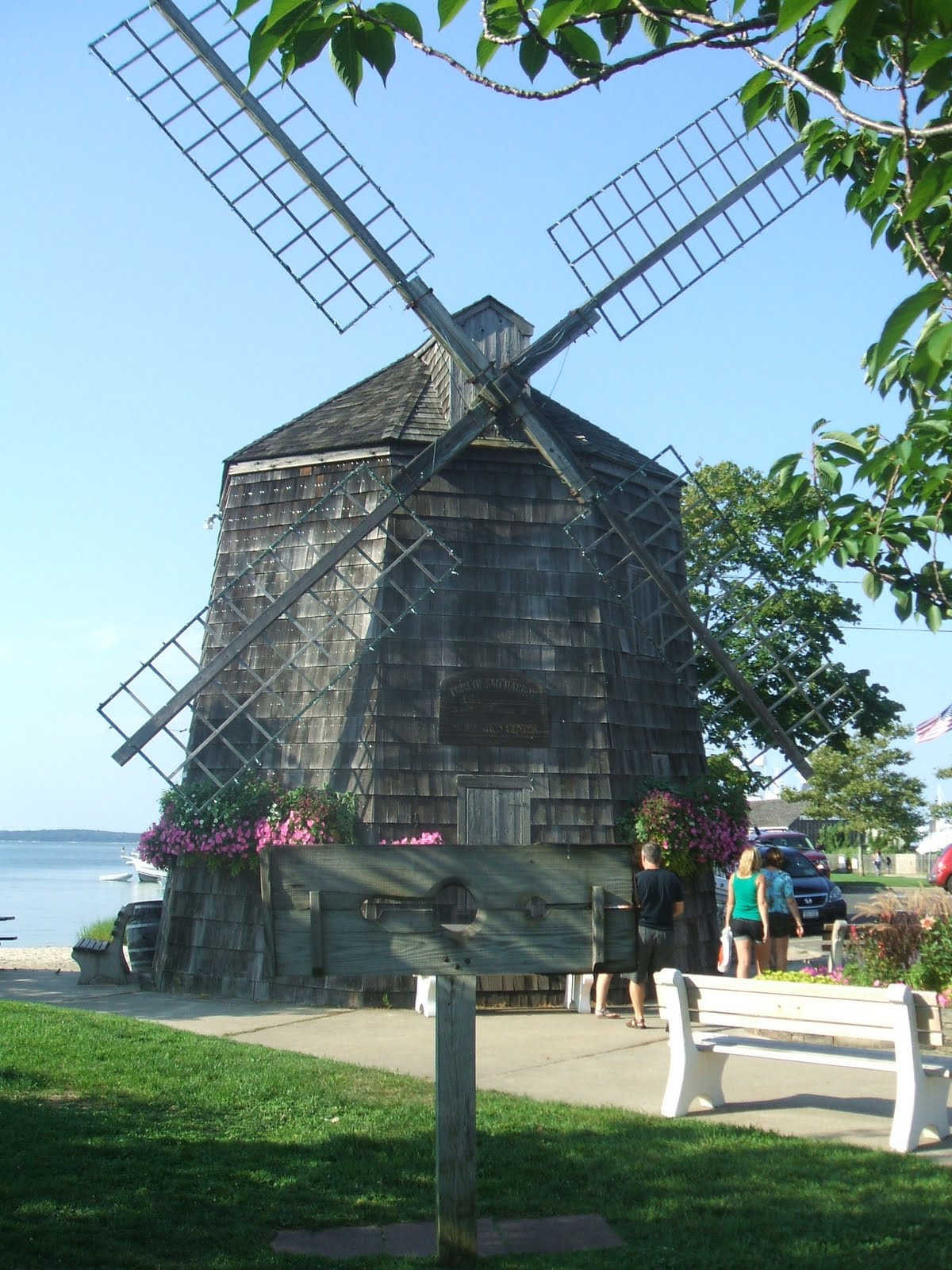

Sag Harbor’s replica of the Beebe Windmill

Our search for the first Lobster Roll of the trip brought us to B. Smith’s Restaurant overlooking Sag Harbor Yacht Club.  B. (Barbara) Smith was the first African-American model to grace the cover of Mademoiselle in 1976.  She is known as an expert in affordable-yet-elegant living and is the proprietor of three restaurants – one in D.C.’s Union Station, one in New York City’s Times Square and one here in Sag Harbor.  While the Lobster Roll was fantastic the service was less than adequate.  Maybe if we had been part of the rich and famous crowd known to dine here we would not have had to go looking for someone to wait on us!  We missed Madonna by four days – she arrived at B. Smith’s by seaplane on Sunday...

Three Mile Harbor is the closest you can get by boat to East Hampton, the pricey summer retreat of the rich and famous.  The charge to dock your dinghy at one of the marinas here was a whopping $125 – but hey, you had access to their shower facilities and pool!  Needless to say we did not dock our dinghy here but instead found a spot at the East Hampton Town Dock and caught a cab to town.  Main Street was lined with pricey shops and high-priced performance cars – Maserati, Porsche, Ferrari, Aston Martin - were plentiful.

One of several Maserati’s parked along Main Street in East Hampton . . .

. . . and a nearby Aston Martin – left unlocked by its owner!

Stormy weather was looming on the horizon so after a stroll down Main Street to gawk at the cars and window shop we grabbed a quick drink at Sam’s Restaurant, hailed a cab and returned to reality aboard Lazy W.  And then the rain came; it rained so hard the galley cabinets leaked even though we were certain that we had plugged up that leak.

Since we had a rain delay – we were to return to Greenport to meet some friends – we used our down time to catch up on some reading.  While perusing the Real Estate section of The Southampton Press an ad for “an early entry beach front home in the happening town of Amagansett” caught my eye.  This four bedroom, three bath, two story home priced at $4,995,000 was described as “truly the best value on the ocean.”  Does this look like a $4.9 million dollar property?

$4,995,000

The deluge was over and it was time to raise anchor and cruise back over to Greenport where we would meet Rich and Terry Wills.  (We had unexpectedly met their daughter Beth while in Baltimore.)  Rich spent many a day of his youth at the family ‘fish house’ along Pipes Cove.  Frank and I had last been here in 1973 after a SUNY Maritime Spring Weekend.  No wonder that we had a difficult time spotting the ‘only brown house’ with ‘a block seawall’ along the cove!  By the time we had set our anchor Rich and Terry had arrived at the house we had picked out and we dinghied ashore to meet them.  It is always great to reconnect with old friends from college and this day was no exception.  We enjoyed a delicious lunch and wonderful conversation at Claudio’s Restaurant on the Greenport waterfront.  A trip to the tasting room at Pindar Winery topped off the day.  Much too soon it was time for Rich and Terry to catch the ferry from Orient Point back to New London and we headed out to reconnect with Lazy W gently swinging on the hook in Pipes Cove.


The following morning we left Pipes Cove by 8AM bound for Montauk.  Strangely enough there was not much boat traffic leaving Greenport or out on Gardiners Bay.  We noticed that it was a bit hazy and about five miles out we encountered the dreaded fog!  On no!  The fog horn was activated as we made our way through the fog bank.  Luckily we hit hazy sunshine before too long and the overcast skies followed us the rest of the way to Montauk. 

Fishing fleet in Montauk – New York’s largest fishing port


We planned to dock at Snug Harbor Marina but it soon became clear that Lazy W was just too big for their narrow fairways and short finger piers.  We backtracked to Montauk Marine Basin where we were directed to the long pier near the fuel dock – perfect.  We had lunch, unloaded the bikes and pedaled three miles to the village of Montauk and the beach.

Years ago this tip of Long Island was better known for its cattle ranching (Deep Hollow Ranch, the oldest cattle ranch in the United States was established here in 1658!) and freshwater fishing on Lake Wyandannee than as today’s tourist destination and angler’s paradise.  That is until 1926 when developer Carl G. Fisher envisioned Montauk as the “Miami Beach of the north.”  There was no EPA to contend with then so he blasted through a narrow spit of land that separated the lake from Long Island Sound.  Salt water Lake Montauk was born!  Now the base for over 150 charter fishing boats and numerous commercial vessels, it never became quite as ritzy or polished as Fisher envisioned it to be due in part to the Great Depression depleting his funds.

In 1898 when Lake Wyandannee was fresh water, Theodore Roosevelt watered his horses along its shore – maybe where Lazy W sits now!  Roosevelt and his Rough Riders and 29,000 other veterans of the Spanish-American War were quarantined at Montauk in an effort to keep the yellow fever-riddled troops form infecting the rest of the populace.

High upon the Turtle Hill bluff at Montauk Point sits the Montauk Point Lighthouse.  Its light is visible nineteen miles at sea.  Authorized by President George Washington in 1792, it was the first lighthouse built in New York.  We enjoyed spectacular Atlantic Ocean views after climbing its circular 137-step staircase to the fresnel lens lantern level.


Also on the bluff is the Lost at Sea Memorial honoring the 100+ fishermen of eastern Long Island who have been lost at sea.

Lost at Sea Memorial


Montauk Point declares itself the “surfcasting capital of the world’ but we never saw any surfcasters!  However, the charter boats back at Montauk Marine Basin were doing a brisk business, leaving the dock twice a day filled with hopeful fishermen intent on landing a trophy fish – tuna, marlin, swordfish and shark abound in the waters outside Lake Montauk.


Bluffs at Montauk Point


We thoroughly enjoyed our twelve days exploring Long Island’s fishtail but as the bumper stick says:


Sunday, August 7, 2011

For the engineers among us from the engineer aboard

Contrary to some people’s belief (John Grubbs :), Lazy W does not get its name from the work habits of her Admiral or Captain.  Rather it is a reference to the constellation Cassiopeia, the Lazy W.  Cassiopeia was our first choice for a boat name but neither of us wanted to have to spell that mouthful (actually we could not spell it!!) when making marina reservations over the VHF, thus Lazy W.


And now, by popular request, here is some information on Lazy W for the engineers in the reading audience.
 
Questions have arisen concerning the electronics onboard.  Here is a quick rundown of the electronics at the upper helm.


Port side electronics

Furuno Echo Sounder Fish Finder (LS-6100) – gives us water depth, latitude/longitude position, speed, and course.  However, the speed gauge never registers above 0.0 knots thus confirming my opinion that Lazy W is indeed a very slow boat!

Standard Horizon GPS/Chart Plotter (CP390i) – new for this trip.  Has now developed an attitude – when turned on it freezes up, beeps and won’t allow itself to be turned off!  The Admiral has to go below and turn off the bridge circuit breakers.  The Captain then makes many attempts to cajole it into restarting which it eventually does.  Many phone calls to tech support over the past few weeks.  Each time a software update is loaded the chart plotter develops new problems.  She was sent on a cross-country trip to CA for repairs and when she returned she was still not working correctly.  We are still dealing with her issues and with tech support.

Also visible are the bow thruster joy stick and the engine gear shift controls.


Starboard side electronics

JRC LCD Color Radar Plotter 1800 – held up our departure from Portsmouth while it was out for repairs in Seattle.  It now works fine.

Throttle Controls (red knobs)

Furuno Nav Pilot – our last boat, Sea Venture, did not have auto pilot capabilities.  We have grown to love this feature of Lazy W.
 
Datamarine Depth Gauge – probably original equipment.  It is a repeater gauge for the lower helm equipment.

We have a Standard Horizon DSC VHF Radio (not visible) and a Danforth Constellation compass (recently reworked by W.T. Brownley).


Center helm – the many gauges we monitor throughout the cruise


Now for the main plant!!!  All of this is underneath the salon floor.  This is Frank’s territory – the comments are his.

Here is the through cabin sole access – provided by a re-worked aluminum stepladder:


________________________________________________________

Of course once you are in the Engine Room, you can see, smell and hear all sorts of equipment:

·          Battery switch

·          8D Batteries

·          Halon Engine Room Fire Extinguisher

·          Inverter

·          Aft head plumbing :-)


_______________________________________________________

·          Gulf Fuel Oil polishing filter

·          Top of Port Lehman engine


________________________________________________________________________________________________


·          Racor primary Fuel oil Filters

·          Air Conditioning water hoses

·          Main Engine Sea Strainer


 _________________________________________________________________

·          Sound enclosure for the 10kw generator


_________________________________________________________


·          Hot Water Heater

·          Fresh Water Filter, gage and pressure switch

·          Fuel Oil Supply Manifold


________________________________________________________


·          Overboard Discharge lines with siphon breakers

·          Generator Battery Selector Switch


_________________________________________________________


·          The forward air conditioner controls

·          The Reverse Osmosis water maker

·          More overboard discharge lines


The main engines are Ford/Lehman diesels.  These naturally aspirated engines are the same displacement as the Yanmar engines on our previous boat, Sea Venture, about twice the weight and half the horsepower!!!!  They are fine for propelling the Lazy W at hull speed (8 knots).  At hull speed we get about 2 nautical miles per gallon (half the fuel consumption of Sea Venture).  However, efficiency declines when the Admiral wants to water ski, and we push her to the blazing speed of 9 or 10 knots. Lazy W rolls more than Sea Venture - largely due to hull shape.  The hull flattens aft and she has chines which help her roll less than other boats we considered.
 
She carries 500 gallons of fuel (ouch!), 250 gallons of water, a huge quantity of food and alcohol plus the two of us!!!

Wednesday, August 3, 2011

A trip down Memory Lane

Since we had rented a car for the week from the Glen Cove Enterprise, we decided to take a trip down memory land to my childhood home in Levittown and Frank’s house in Massapequa.

Levittown was once flat, treeless potato farm country.  Farmers let the vast acres of land go pretty cheaply when nematodes wiped out their crop in the 1930’s. After World War II, William Levitt and his sons developed the area to meet the housing demands of returning GIs and their new families.  At the peak of construction, thirty houses were being built each day for a selling price of $7,990!!  My parents bought this one at 32 Prentice Road in 1950.


Built on a concrete slab, it had two bedrooms, one bathroom, a living room separated by a fireplace from the kitchen with a GE oven and a Bendix washing machine, plus an attic.  More than 17,000 of these houses were built between 1949 and 1951.  All were a far cry from the mansions of Long Island’s Gold Coast!

Here is the house today.  The only recognizable feature is the push out bathroom window partially hidden behind the tall corkscrew bushes.  Like every other Levitt house, its original bones are now hidden behind major expansions and remodeling.  No plaque marks the property as the home of the Buckheits from 1950 until 1966.


On to 348 Forest Avenue in Massapequa.  Frank’s old house looked the same except for a new exterior of aluminum siding, a chain link fence and some overgrown bushes.


Since Frank’s Aunt Arlene still lives nearby, we stopped in for a short visit.  She proved to be an informative repository chock full of Wiegand/Werner family history!

And as good friend John Wolak celebrated his 60th birthday in Richmond, VA we had dinner at Huntington’s Canterbury Ales with his and Frank’s fellow Maritime College classmate, Andy Charlton.

One of THE TOP TEN THINGS to do on Long Island the week of July 24th (at least according to Newsday) was the Shop Super Saturday, a celebrity-studded designer garage sale hosted by Kelly Ripa.  With tickets priced at $450-$650, we opted instead to attend the 6th best thing to do – The Feast of Saint Rocco.  The self-proclaimed ‘best feast in the east’ takes place in Glen Cove to honor Saint Rocco, patron saint of dogs and protector against the plague and contagious diseases.  Who could pass up all that great Italian pasta and pastries plus the Giglios, an Italian marching band? 


Added entertainment was provided by Vic Vincent.  He and his band played favorites from the 50’s, 60’s and 70’s made popular by Italian-Americans – Dion, Frank Sinatra, Dean Martin, Frankie Vallie and Johnny Cash (?).

Our ‘semi-repaired’ GPS/Chart Plotter returned to us on Wednesday from its weeklong cross-country trip to California and back.  With all her electronics back on board, Lazy W was ready to leave Glen Cove Brewers Yacht Yard and head east to Port Jefferson. 

Port Jefferson looked like a great place to dock 43-foot Lazy W in a marina since the town fans out from the waterfront.  However, the fee for ‘non-resident transients’ at Port Jefferson Town Marina was an astounding $6 per foot per day plus a daily fee for electric.  That is more than we want to pay for a room in a nice hotel – and we were bringing the room!!!  So we snagged a mooring ball from Setauket Yacht Club for $50 and hailed the SYC launch for a lift to the town dock.

A tribute to the shipbuilding past of Port Jefferson

Port Jefferson was originally called Drowned Meadow because the downtown area was tidal and "drowned" by the tide twice a day.  Drowned Meadow was not a pleasant name for a town and it was later changed to honor Thomas Jefferson.  P.T. Barnum of circus fame owned a tract of land here.  Local lore claims that he intended to make Port Jefferson the home base for his circus but the townspeople put a stop to that plan.  The reality is that he owned hundreds of properties across the Long Island Sound in Bridgeport, CT and that town was the winter quarters of the circus from 1880 until 1927.   Barnum even served as Bridgeport’s mayor in 1875.  Nevertheless, Barnum Avenue now runs through the tract of land he once owned in Port Jefferson and one of the Bridgeport-Port Jefferson ferry boats bears the name ‘P.T. Barnum.’


The woman manning the Chamber of Commerce desk highly recommended that we attend that night’s free Harborside concert featuring Desert Highway, an Eagles tribute band.  They lived up to her praise and provided the fans with ninety minutes of incredibly great music.
 

The following evening we enjoyed the company of Frank’s Uncle Lawrence, Aunt Mary and cousin ‘little’ Larry.  Our heartfelt thanks to all for great food and conversation at Ruvo’s Restaurant.  (Once again I carried the camera along but failed to capture the moment!)   The threat of severe thunderstorms never materialized so we were able to ride the open SYC launch to and from town with no fear of being struck by lightning!


Sunday, July 24, 2011

From The Big Apple to Long Island's Gold Coast

Monday morning, July 18th – There were two reasons we wanted to make an early departure from Lincoln Harbor Yacht Center.  First, the choppy water within the marina would turn even choppier once the commuter-filled high speed ferries began crisscrossing the Hudson River.  And second, the infamous water of Hell Gate stood between us and our destination for the day, the Long Island Sound.

Hell Gate is where the strong currents of the East River meet the waters of the Harlem River near Mill Rock.  Its reputation for strong, reversing currents (4 to 5 knots), large waves, and heavy commercial traffic is well-deserved.  Timing your safest, least harrowing passage through the area is dependent on the tidal currents.  After consulting Eldridge Tide and Pilot Book, Frank determined that an early departure from LHYC would be prudent.

Lazy W’s engines were purring; by 6AM we had thrown off the lines and were ready to go.  While I stowed the fenders and tidied up the lines, Frank put Lazy W in reverse.  No movement!  I wondered if we had lost reverse gear.  Frank wondered if we had forgotten to undo all the lines.  Neither one of us was correct.  Lazy W’s bow was sitting in mud!  Even though there was 40+ feet of water in the Hudson River, there was less than 4 feet in the marina.  We tied up again waiting for the incoming tide to release the bow.  A half hour later the bow was swaying in the water so we made a second attempt to leave.  We extricated Lazy W from the slip and dredged our way through the fairway to the Hudson River.

Numerous NY Waterway taxis were already traversing the Hudson and speeding up and down the East River.  It was a gorgeous morning for a cruise past the South Street Seaport...


...and under the Brooklyn Bridge...


...and up the East River passing the Chrysler Building.


Our timing through Hell Gate was just about perfect.  There was no on-coming commercial traffic to intimidate us and the current was running in our favor.  Before long we were approaching the Throgs Neck Bridge, the demarcation line between the East River and the Long Island Sound.  Under the bridge at Fort Schuyler is Frank’s alma mater, SUNY Maritime College.  


Manhasset Bay is on the south shore of the Long Island Sound about 5 miles east of the Throgs Neck Bridge.  The town of Port Washington manages a mooring field of 10 yellow balls that are available to cruisers for two nights free of charge.  Amazingly there were several mooring balls available just off green buoy 3A and we snagged one for Lazy W.  We spent several days here bobbing amidst the hundreds of sailboats, occasionally taking the dinghy into town where we stuffed ourselves with calamari and clams oreganata during happy hour at Louie’s Oyster Bar and Grille or feasted on incomparable NY pizza at any of the pizzerias along Shore Drive.  We made time to dinghy around the bay to gawk at the surrounding pricey real estate.


After dinner one evening we had some unexpected visitors to the boat.


The heat wave gripping the eastern seaboard was getting a bit unbearable.  Lazy W has air conditioning but in order to use it at anchor we need to run the generator.  Since there is little insulation on Lazy W to keep the cool air in and the heat out, as soon as the generator and A/C are turned off the temperature aboard begins its upward climb.  We needed to spend some time in a marina where we could plug in and run the A/C 24/7.  Brewer’s Yacht Yard in Glen Cove, here we come!

Glen Cove’s location on the North Shore of Long Island seemed like a good place to rent a car and do some touring to sites that we would find hard to access by boat, bike or foot.  Sagamore Hill, the Cold Spring Whaling Museum and the Vanderbilt Mansion were on our list of must sees.

On the hottest day of the record breaking heat wave we visited Sagamore Hill, the un-air-conditioned home of Theodore Roosevelt.    TR, our 26th president, was born in New York City in 1858.  He served the country in many capacities – Assistant Secretary of the Navy, a Rough Rider in the Spanish-American War, Governor of New York, and Vice President under William McKinley.  He became the youngest president of the United States upon McKinley’s assassination in 1901.  Sagamore Hill, his estate at Oyster Bay, became the “Summer White House” from 1902-1909, hosting many leaders and dignitaries from around the world.


The 23 rooms of Sagamore Hill are filled with the original furnishings of the Roosevelt family.  The personality and spirit of Roosevelt fill the house – 6,000 books fill his library shelves, bear skin rugs cover the floors and, most disturbingly, heads of enormous water buffalo and deer from his many hunting expeditions and safaris peer down from the walls.  His Rough Rider hat and sword hang precariously from the antlers of one such head.

An avid sportsman and hunter, Theodore Roosevelt was also a staunch conservationist.  During his presidential term he doubled the number of national parks, set aside 100 million acres of national forests, and signed into law the Antiquities Act which enabled him and his successors to proclaim historic landmarks and structures as national monuments.

The stuffed bear of our childhood that we all know as Teddy Bear was named after Theodore Roosevelt.  The story goes that in 1902 he refused to shoot a sickly bear on a hunting trip.  That moment was immortalized in political cartoons.  The founders of the Ideal Toy Corporation seized this as a great marketing opportunity and asked Roosevelt’s permission to give his name to a new stuffed bear that they were getting ready to sell.  The rest is history...


Cold Spring Harbor was one of Long Island’s leading whaling ports from 1836-1860.  The Whaling Museum on Main Street is filled with fine examples of scrimshaw, ship models, and photographs from that time period.  A fully equipped whale boat dominates the exhibits.  When a lookout perched high atop the whale ship’s rigging spotted a whale, a six man crew would launch one of several whale boats and row out to the whale.  The harpooner would spear it and the crew would eventually row back to the whale ship with the whale in tow.  Here the whale would be processed into whale oil for illumination, lubricating oil for machinery, and whalebone, the flexible plastic of that time period.   The museum also houses an exhibit ‘From Prey to Protection’ which explores the changing attitudes towards whaling.


At the turn of the last century, Long Island’s north shore was home to such extravagant wealth and style it became known as the “Gold Coast.”  America’s wealthy industrialists amassed great fortunes in a time before there existed any sort of federal regulation or taxes on acquired wealth.  Families such as the Vanderbilts, the Fricks, the Pratts, and the Guggenheims built the American equivalent of castles and chateaus.  More than 500 mansions graced Long Island in the early decades of the 20th century.  Although many of these homes proved to be too large and inefficient to maintain and were demolished, some still exist today, though in another capacity – as a college, a museum, a planetarium, a religious institute, a conference center or state and county parks.

The summer home of William K. Vanderbilt II, great grandson of Cornelius Vanderbilt, overlooks Northport Harbor in the town of Centerport.  Cornelius built his wealth in shipping and railroads.  Willie reaped the benefits of the family wealth.  As a young man his passion was motor car racing and he and his wealthy friends went so far as to build the 45-mile Vanderbilt Motor Parkway from Flushing in Queens to Lake Ronkonkoma to host the Vanderbilt Cup races!  The first section of the parkway opened in 1908.  He was also an avid sailor; he owned many yachts and circled the globe numerous times. 

Vanderbilt’s 24-room, Spanish Revival mansion was built in stages between 1910 and 1936 and reflects the eclectic tastes and collecting interests of Mr. Vanderbilt.  You can’t name your estate ‘Eagle’s Nest’ and not have some eagles present.  The two large eagles flanking the entrance to the estate were taken from the original Grand Central Station.  Just beyond is a grassy area that has columns taken from the ancient ruins of Carthage.  A pathway of Belgian blocks winds through the grounds.  The entrance to the house features a bell tower with a spiked gate overhead to mimic a castle’s portcullis.

 The bell tower topped entrance to the Vanderbilt mansion

The shopping malls of the wealthy were the monasteries and cathedrals of Europe.  As was typical of many of the grand estates of the Gold Coast, the Vanderbilt mansion is filled with fixtures, tapestries, art works and antiquities from around the world.  There is an excess of taxidermy throughout the house with an entire wing dedicated to birds, butterflies, and large land animals.   It is hard to believe that while the country was in the throes of the Great Depression the Vanderbilts were having bath tubs carved from single slabs of marble and living in such grand surroundings!  Such uninhibited wealth and opulence of this era have been forever immortalized in F. Scott Fitzgerald’s book, The Great Gatsby. 


Wednesday, July 20, 2011

The Big Apple

July 13, 2011 – After 37 years of marriage the most romantic way to celebrate was a ten hour, 90-mile run up the coast of New Jersey?!?! 

Bringing up 125 feet of mud-caked anchor chain took longer than anticipated especially since the anchor was fouled with a large flap of maroon boat canvas.  We still managed to get underway by 6AM from Atlantic City.  The Atlantic Ocean was good to us – gentle swells and sunny skies all the way to Asbury Park where, despite the chances of precipitation being only 20%, it rained hard enough for us to button up the canvas at the helm.  The rain was short-lived.

We have come to expect conditions at Sandy Hook to be less than comfortable so we were not surprised by the gusty north winds and rolling seas here.  And unlike an infamous day in Spring 2002, there was no fog to contend with so the Admiral did not feel an overwhelming need to down several Margaritas at the end of the cruise!

Rounding Sandy Hook we decided to forego a stop at Atlantic Highlands and pointed Lazy W across Lower Bay to Great Kills Harbor on Staten Island.  This protected, tree-lined cove was bespeckled with mooring balls and sailboats.  We gingerly picked our way through them before dropping anchor, breaking out the Margaritas, and celebrating our uneventful trek up the coast – oh yeah, and our anniversary too!  Love ya, Captain!

We spent another day in Great Kills Harbor and not because the folks at Richmond County Yacht Club were warm and welcoming – they were not!  RCYC manages the field of mooring balls and since we could not raise them on arrival via the VHF to secure one, we were not greeted warmly at their ‘for guests only’ dinghy dock.  We quickly ran in for a bag of ice and headed across the harbor to Gateway National Recreation Area run by the U.S. National Park Service for ice cream and Italian ice – exactly as Frank remembered it from his childhood days in Brooklyn (except for the price!).

Wanting to get an early start to ride the favorable currents in New York Harbor, we were up with the sun.  The anchor chain was muddy and littered with fishing lines and hooks.  No sooner had I secured the anchor on the roller at the bow pulpit when the starboard engine sputtered and stalled.  The anchor was put out once more while Frank scrambled below to change the fuel filter.   He has become quite adept at this task and we were ready to go in no time – except that now the engine would not start.  Despite repeated efforts by the Captain and the Admiral, she refused to turn over.  Finally Frank concluded that the solenoid was faulty but he managed to jump start her and we left Great Kills Harbor 90 minutes after our original attempt.

Wind and weather were great!  We encountered some impressive commercial traffic on the move at the Verrazano Narrows Bridge.
 
Nordrhine southbound under the Verrazano Narrows Bridge
which connects Staten Island and Brooklyn


New York Harbor lived up to its reputation as one of the world’s busiest!  Numerous Staten Island ferries and New York Waterway taxies spewing great fantails of water, plenty of go-faster boats kicking up huge wakes, dozens of anchored barges, Statue of Liberty/Ellis Island tour boats, Celebrity and Holland America cruise ships, fireboats, Coast Guard vessels – it’s all here to ratchet up the anxiety levels of newly arrived pleasure boaters, Us!

The Staten Island ferry, John F. Kennedy


To our starboard side the Wallenius Wilhelmsen was keeping pace with Lazy W until its captain radioed a request that we slow down so he could turn to port ahead of us and make way to Bayonne.  Who could argue with that behemoth?


And then you pass the Statue of Liberty, an awesome sight with her torch rising 300 feet above the water as a beacon of entry into the free world. 


Across the river, the Freedom Tower is finally rising over the tightly packed skyscrapers of lower Manhattan.


We continued north along the Hudson River to Weehawken, New Jersey and the Lincoln Harbor Yacht Center.  On previous visits here we found the wakes from all the commercial traffic bounced so frequently through the marina that you felt seasick while tied up at your slip!  But a recent advertisement in a cruising guide proclaimed that ‘we’ve tamed the Hudson’ with a new seawall designed by Stevens Institute of Technology and that LHYC was now ‘calm and quiet.’  Well, it wasn’t!  New rubber collars around the pilings had quieted the shrill noises that had accompanied the rise and fall of the floating docks but boats still bobbed and quaked viciously throughout the marina.  But the view across the Hudson of midtown Manhattan is priceless.  We stayed three days!


Frank did a great job (as usual) fighting the currents in the marina and getting Lazy W into a narrow slip.  He was still quite miffed by our GPS issues, our engine starter problem, our fuel problem, and a faulty knee joint.  The updated chip for our GPS was waiting for us at the marina office – too bad that it was already outdated and, though it solved its startup problem, it created a host of others.  A revision was on its way!  Further troubleshooting determined that the engine starter problem was most likely due to operator error and a finicky key that sometimes slips from its required position thus preventing the engine from starting.  The fuel problem may be due to lack of marine grade hoses that may need replacement.  The faulty knee joint is due to old age and will have to be tolerated for now.

We were glad to spend our first evening near the Big Apple in the company of our friend, Jim Rich.  Dinner at the Chart House, cocktails on Lazy W – a great night.  As requested Jim arrived with a grease gun so that the next morning the Captain could grease the Admiral’s creaky anchor windlass.  Jim took us for provisions in Hoboken before he left for Long Island.  Thanks Jim!


Our chores somewhat completed, it was time for some sightseeing.  We hopped on the Hudson-Bergen Light Rail to Newport/Pavonia (near where Jon and Nancy lived before their move to Thailand) where we switched to the Path train to the World Trade Center stop.  Nearly ten years after 9/11, Freedom Tower is rising from the WTC site.  It now has steel reaching to the 72nd floor and glass wall panels reaching to the 44th floor.  When completed the tower will have 104 floors and will be 1,776 feet high, including the 400-foot spire.  Publishing giant Condé Nast has already signed a 25-year lease to occupy a third of the commercial space – the 21st through 40th floors.


 There is plenty of history to be appreciated in Lower Manhattan.  We paused at the New York Stock Exchange.  On this site in 1792, twenty-four brokers began trading shares on the sidewalk on Wall Street.  The present building was constructed in 1903.
 

At the corner of Pearl Street and Broad Street sits Fraunces Tavern, the oldest surviving structure in Manhattan.  George Washington and the officers of the Continental Army spent a lot of time conferring in this building which is not only home to a restaurant and tavern but also houses two floors of Revolutionary War artifacts, paintings and antiques.  In 1783, George Washington bade farewell to his officers in the tavern’s ‘long room.’  We joined a tour and spent a few hours relearning our American history.

From 1892-1924, the immigration station on Ellis Island processed over 12 million immigrants seeking entry and a new life in America.  In 1954, Ellis Island was abandoned and fell into disrepair.  Fundraising efforts in the 1980’s by Chrysler’s Lee Iacocca, himself a son of Italian immigrants who passed through Ellis Island, helped fuel its restoration.  Today the minaret-topped, castle-like structure has been restored to its 1900’s appearance to give the visitor a sense of what greeted the hopeful immigrants who reached our shore after long and arduous journeys aboard crowded steamships.

A visit to Ellis Island had been on my bucket list for years so we boarded a ferry from Liberty State Park early on Sunday morning.  A park ranger led a tour through Registry Hall giving us a step-by-step overview of the entry process – the medical review, the legal questions, the money exchange.  One poignant exhibit, Treasures from Home, displays some of the possessions that the immigrants deemed necessary to bring from their homeland – everything from linens to rolling pins, tools of their trade to teddy bears, china, photographs and sewing machines.


Ellis Island

The ferry to Ellis Island also stops at Liberty Island where the 151-foot Statue of Liberty (Liberty Enlightening the World) stands.  Given to the United States by France to honor the American ideals of freedom and liberty, she has been standing watch over New York Harbor since 1886.  Millions of tourists visit her each year.

Another packed tour boat arrives at Liberty Island

Whenever we plan for an extra early departure something inevitably happens to thwart our plan.  July 18th would prove to be no exception...